Picked, Not Chunked: Why Grapple Trucks and Cranes Change a Big Removal
Lifting a big piece out beats cutting it into firewood and hauling it by hand.
October 13, 2026 · 4 min read
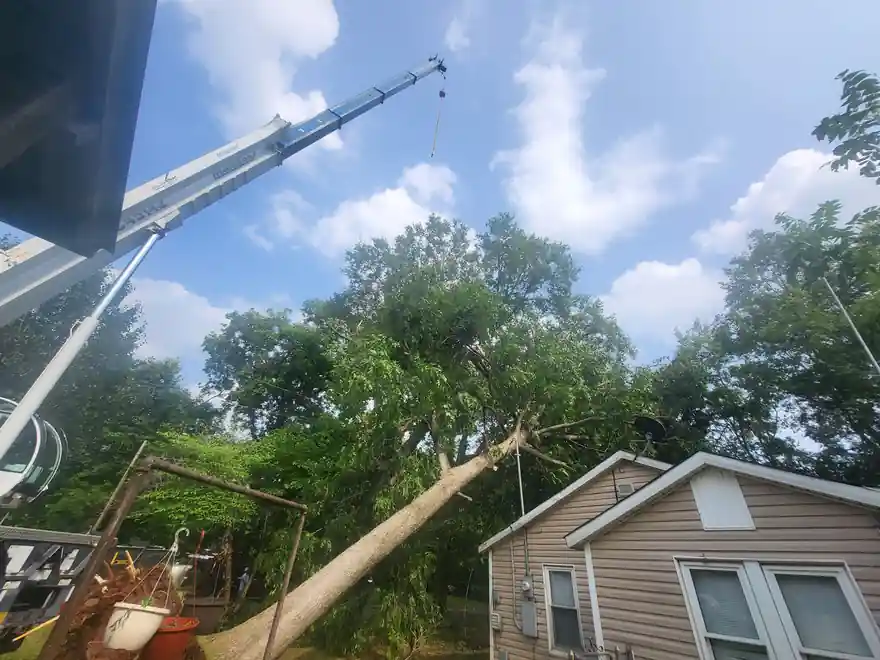
Picture a tall pine behind a house in Tyler, with a fence on one side and a pool on the other. There are two ways that job can go. One crew cuts the tree into hundreds of small pieces, carries or drags them across the lawn, and loads them by hand. The other crew picks big sections out with a machine and sets them on a trailer.
We call the second approach picked, not chunked. Lester's Tree Service leans on grapple trucks and cranes for the heavy pieces, and the difference shows up in your schedule and in your grass.
How most removals go without the big equipment
When a crew doesn't have a machine that can lift much weight, everything has to be small enough for a person to handle. That means cutting the trunk into rounds you could carry, or cutting limbs into firewood sizes and walking them to a truck. It works, and plenty of good crews do it. It is also slow, hard on the crew, and rough on the ground, since all that foot traffic and dragging leaves paths through your lawn.
Lester's own site puts it plainly: where others laboriously cut trees into small firewood sizes for manual removal, their machinery can lift significantly larger pieces. That one change cuts a lot of steps out of the day.
What a grapple does
A grapple is a set of hydraulic claws on the end of a boom or loader arm. It closes around a log or a bundle of limbs, lifts it, swings it, and drops it where you want it. On a knuckle-boom grapple truck, the arm can reach out over a fence line or across a driveway and load a trailer without the truck leaving the road. A track loader with a grapple does the same thing in a tighter, softer yard, and its tracks spread the weight out.
Once a climber or a lift has put pieces on the ground, the grapple moves them fast. A pile that might take two people half a morning to carry can be loaded in a handful of lifts. The crew spends its energy on the cutting and the rigging instead of hauling.
Where the crane comes in
Some trees can't be dropped. They lean over a roof, stand between power lines and a fence, or sit in a backyard that no truck can reach. In those cases, a crane can take hold of a section while the climber cuts it free, then lift it straight up and away from the house instead of letting it fall or swing.
That is the controlled version of a hard job. The piece never touches the roof, the fence or the garden, because the crane carries its weight the whole time. A spider lift, the tracked aerial lift with a long reach, does a similar job for crews who need to work high in a tree over a building without climbing every limb.
What this means for your yard
Fewer trips across the grass means fewer ruts, fewer broken sprinkler heads and less to rake up afterward. Lifting pieces out whole also keeps the cut count down, which means less sawdust and fewer small chunks hiding in the turf.
Customers notice. Aaron wrote in a Google review that the crew cleaned up a huge tree that had fallen, plus parts of two others, “all without damaging my yard.” DustyBoo Rescue Crew said the team took down a massive tree in one day and left no mess behind. Speed and a clean site go together when the machine does the lifting.
Equipment also changes timing. A big removal that would eat two or three days with hand-carried pieces can wrap up in a day when the machines are doing the heavy work. That matters if you've got a roof open to the weather or a driveway you need back.
What the machines don't replace
A grapple truck and a crane don't climb, rig or make decisions. Someone still has to read the tree, pick the order of cuts, and set the ropes and slings so each piece hangs the way it should. The machine makes a good crew faster. It doesn't turn an untrained one into a safe one.
That is why we point to the people alongside the iron. Lester's runs three crews, every crew member is insured, and the team takes National Arborist Association training on safety and professional tree care. Ask any crew you're thinking of hiring about their insurance and their training, and ask what equipment they would bring to your property.
Not every tree needs the big equipment. A small ornamental tree in an open yard may need nothing more than a climber and a chipper. A large pine near a house in Bullard, Lindale or Whitehouse is a different story. A walk around the property tells us which tools the job calls for, and the quote reflects the equipment as well as the height, wood type and condition of the tree.
If you have a big removal coming, call (903) 978-0098 and ask for a free quote. We'll look at the access, tell you what we'd bring, and explain how we would get the tree out without tearing up your yard.
Lester's Tree Service, (903) 978-0098
Call (903) 978-0098More articles
The First Hour After a Storm Drops a Tree on Your House
The first sixty minutes decide how safe and how costly the next few days will be.
Remove or Trim? How to Tell if a Tree Really Has to Come Down
Plenty of trees that look doomed need a trim, and a few that look fine are close to failing.