The First Hour After a Storm Drops a Tree on Your House
The first sixty minutes decide how safe and how costly the next few days will be.
October 13, 2026 · 4 min read
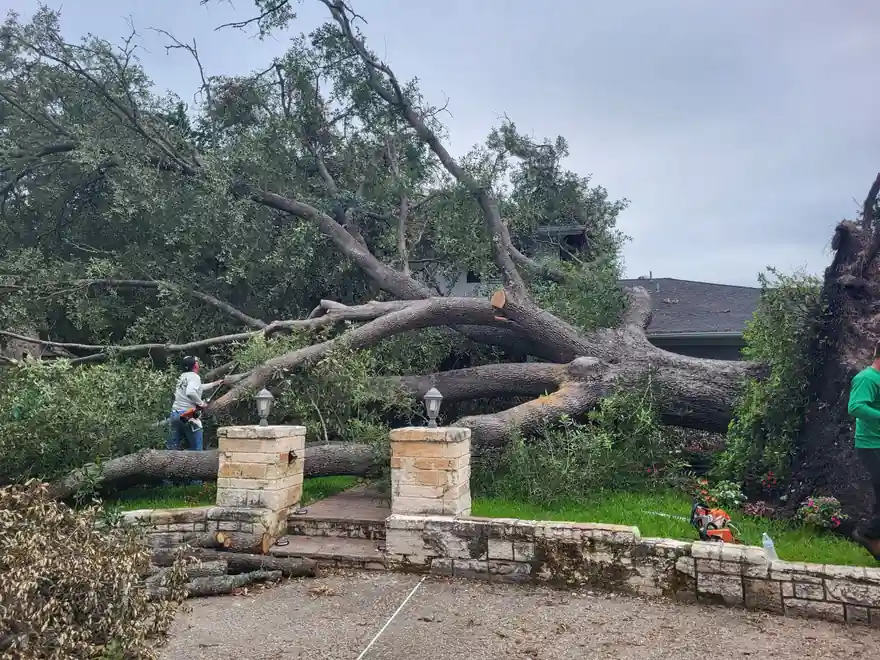
A big wind rolls through Bullard or Tyler at two in the morning, and you wake up to a sound you won't forget. Then you find the oak across the driveway, or the pine leaning on the roofline. The first hour matters more than almost anything that happens later, because most of the real danger exists before anyone with a saw shows up.
None of this is complicated. It is mostly a matter of doing a few things in the right order and resisting the urge to start cutting.
Check on people before you check on the tree
Walk through the house and count heads. Look for anyone who is hurt, then look at the rooms under the damaged part of the roof. Stay out of any room where the ceiling sags or where you can see daylight through the framing.
A roof that is carrying the weight of a tree can shift when the wind comes back or when someone walks underneath it. If a bedroom or hallway sits right below the trunk or limb, move out of it and stay out until the tree is off. Furniture can be replaced. Nobody should sleep under a loaded roof.
Treat every wire as live
Trees fall into power lines, phone lines and cable. A line lying in wet grass can look dead and still carry current, and a branch touching a line can pass that current through the wood. Stay well back from any wire you can see, and keep kids and dogs inside.
Call your power company from a safe spot and tell them a line is down. Don't try to push a limb off a wire, even with a wooden rake or a broom handle. Getting that call made early keeps the rest of the day moving, because a crew has to work around the line situation before any cutting begins.
Take photos before anything moves
It feels strange to stand in the yard with your phone while the rain drips off a broken tree. Do it anyway, from wherever you can safely stand. Your insurance company will ask what happened, and clear pictures taken before cleanup answer that faster than memory does. Try to get these:
- The whole tree from a distance, so the size and the angle of the fall show.
- The spot where the trunk or limb meets the house, fence, barn or vehicle.
- Broken shingles, gutters, siding, window glass or fence panels.
- The stump or the lifted root plate, if the tree uprooted or snapped off.
Write down the time you called each person too. A short list on your phone is plenty.
Keep the weather out if you can do it safely
East Texas storms rarely come alone, and an open roof turns a bad night into a bad week. A tarp can help, but only if you can put it on without climbing under a tree that is still resting on the structure. If there is any doubt, skip it and let the crew handle the cover.
Kimberly Kelly had a tree snap and land on her barn. In her Google review she wrote that Lester came out right away to look and give a quote and was back in the morning to finish, and that the crew “patched up the holes until roof is fixed.” That kind of temporary patch is often the difference between a wet interior and a dry one while the roofer gets scheduled.
Why you shouldn't pick up the saw yourself
A fallen tree is not a relaxed tree. Trunks and limbs that look like they are resting can be under heavy tension, bent against the ground, the roof or each other. Cut the wrong piece and the load can spring, roll or drop onto you or onto the house.
Oaks and pines break differently, too. A snapped pine often splits a long way up the trunk, and the split can run past where you think it ends. A big oak limb that tore off can hang by a strip of bark above the spot where you are standing. Reading that takes a lot of practice, and a ladder plus a chainsaw is how neighbors end up in the emergency room.
Crews doing this work every week use climbing gear, spider lifts, cranes and grapple equipment so that the heavy pieces come off in a controlled order. Lester's Tree Service runs three crews, and every crew member is insured, which matters when the job is a tree sitting on somebody's home.
When you call, give the town, what the tree is touching, and whether any wires are involved. Tell them if the driveway is blocked, if anyone is trapped in a room, or if water is getting in. Those few details let a dispatcher decide what equipment to send and what to do first.
Lester's takes emergency calls around the clock, in Bullard, Tyler, Whitehouse, Lindale, Jacksonville and the other East Texas towns on its service list. If the tree isn't an emergency, you get a free quote with no obligation. If it is an emergency, say so at the start of the call.
Tree down and the storm still going? Call (903) 978-0098, day or night, and we'll get a crew headed your way with a free estimate.
Lester's Tree Service, (903) 978-0098
Call (903) 978-0098More articles
Remove or Trim? How to Tell if a Tree Really Has to Come Down
Plenty of trees that look doomed need a trim, and a few that look fine are close to failing.
Picked, Not Chunked: Why Grapple Trucks and Cranes Change a Big Removal
Lifting a big piece out beats cutting it into firewood and hauling it by hand.